

Russia votes for a new parliament this week. The Kremlin has spent two months making sure nobody notices – and what it did to the one party that offered peace explains why.
In the first six days of Russia’s parliamentary election campaign, the country’s federal television channels gave it less than seventeen minutes of coverage. Not each. Between them. In four out of five news bulletins, the election was not mentioned at all.
This is a country where television still decides what most people know. The silence was arranged.
On 18, 19 and 20 September, Russians choose all 450 members of the State Duma for the next five years. Some 111 million people are entitled to vote. It is the first parliamentary election since the full-scale invasion of Ukraine, the first staged in occupied Ukrainian territory, and the first real test of what Russians will say about the war when they are handed a ballot paper instead of a telephone survey. By any ordinary measure it is the largest political event in the country since 2021, and it has been muffled almost to the point of invisibility.
The result was never in doubt. United Russia will keep its majority and everyone involved knows it. What the Kremlin has been managing since the summer is something else: a number it did not expect to see, produced by a party it had written off.
The party written off
Yabloko has spent two decades on the margins of Russian politics. No seats in parliament since 2003, a leadership most voters would struggle to name, a reputation among younger Russians for belonging to their parents’ era. On 29 July the Central Election Commission registered its list unanimously. Its platform ran to forty-three words: a ceasefire, diplomacy, preventing nuclear war, freedom from fear and political repression, a prosperous democratic Russia. On a ballot of a dozen parties, it was the only one asking for the war to stop.
Grigory Yavlinsky, who founded the party three decades ago, had been explicit about what it was for. Writing on 27 July, he said the party was not counting on entering parliament and had no intention of devoting itself to that. The point was to let a large number of people state, by secret ballot, that they wanted the fighting to end, and to have that number existwhatever was announced afterwards. It was a modest ambition, and it turned out to be too much.
The number
In late June, before any of this began, the state’s own pollster measured the ground. VTsIOM – government-owned, and with no interest in flattering an anti-war party – found that between 15 and 18 percent of Russians would consider voting for Yabloko. For a party that had polled around two percent for a decade, that was an extraordinary reading, and it was the government that took it.
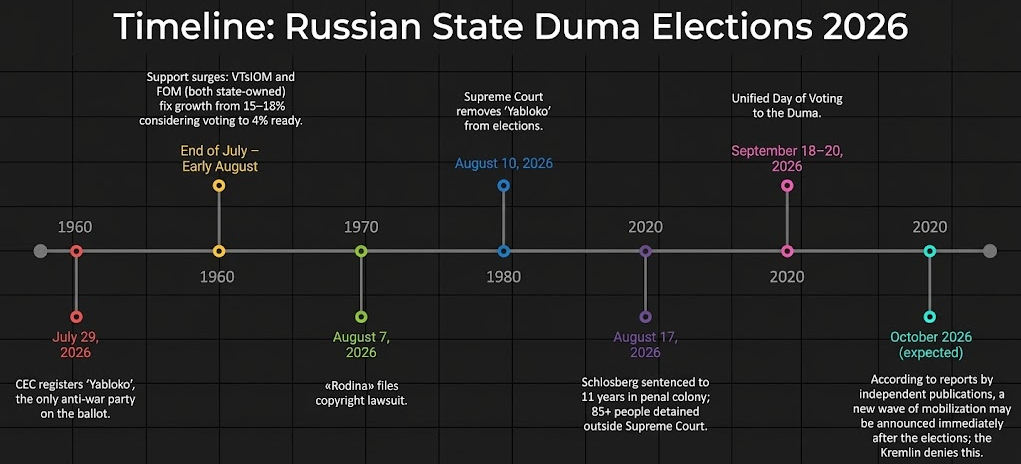
Then the campaign began and the number started to harden. FOM, the other state-funded pollster, recorded Yabloko at four percent in fieldwork on 7 to 9 August, double its level a week earlier and its strongest showing in years. A closed FOM survey in July had reportedly put it at eleven percent in Moscow and St Petersburg. Independent researchers at ExtremeScan later estimated that had the campaign been allowed to run its course, the party might have reached eighteen to twenty percent. None of these are landslide figures and they did not need to be. What they described was a slope, measured by the government’s own instruments, pointing in a direction the government had spent four years insisting did not exist.
Apples
The visible part happened on the phones of people too young to remember Yabloko’s last parliamentary seat. Videos began circulating in which young Russians filmed themselves with apples, cutting them, eating them, holding up pictures of them. No slogan, no party name, nothing a prosecutor could easily charge, and everyone understood. Then the exiled opposition, which had spent years in bitter argument with Yabloko, closed ranks behind it: Ilya Yashin, Vladimir Kara-Murza, Lyubov Sobol, Oleg Orlov. On 6 August Yulia Navalnaya recorded a video endorsement, saying it was morally and politically right to support the party and that this was the moment to set old disagreements aside. Within a fortnight, a party the presidential administration had regarded as politically dead was the most discussed in the country.
Eleven days
On 7 August, Rodina, a small pro-Kremlin party, filed suit in the Supreme Court demanding Yabloko’s removal. The grounds were copyright: a well-known Soviet children’s song, whose creators’ descendants publicly said they had no objection; photographs taken from news outlets and archives, among them an image of Hiroshima and a tank standing in sunflowers; illustrations generated with ChatGPT for an article of Yavlinsky’s. On the morning of 10 August several hundred people gathered outside the court on Povarskaya Street, one observer putting the share under twenty-five years old at no less than ninety percent. They drew apples and peace symbols in chalk on the pavement. Police asked them to keep the noise down and made no arrests that day. Inside, the court granted Rodina’s claim. Eleven days after registering the only anti-war party on the ballot, the Russian state removed it.
What those eleven days produced was a measurement. For four years the Russian state had insisted that the country stood behind the war and that those who disagreed were a marginal few. Then it allowed the question onto a ballot paper, watched its own pollsters record the answer, and took the paper away.
How it did that without breaking a single law, and what it was protecting, is the subject of the second part of this article.