



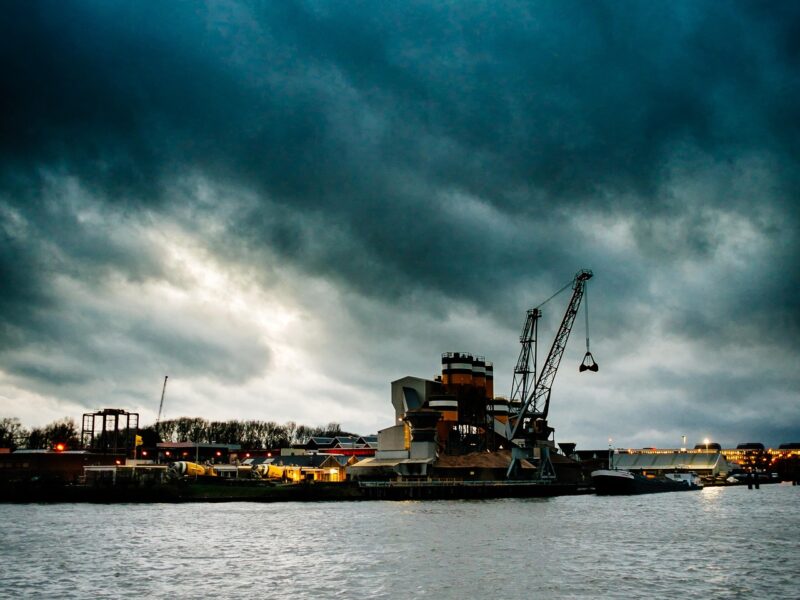
In March 2026, Ukraine’s largest commercial seaport got a new director. He had no maritime background, no industry experience, and no obvious reason to be there. Within two months, the port had lost eighty percent of its cargo volume.
THE APPOINTMENT
Port Pivdennyi is not a routine posting. Situated thirty kilometers east of Odesa on the Black Sea, with a navigable draft of 18.5 meters, it is the deepest commercial port in the northwestern Black Sea and the largest by cargo volume in Ukraine. In 2024, it handled 35.5 million tons of grain, ore, and fuel destined for more than fifty countries. It is the kind of facility that requires, at minimum, someone who understands how ports work.
Artem Litvinov does not have that background. His prior career was spent in minor commercial structures in Donetsk Oblast, far from any maritime industry. He holds no relevant professional qualification. Before March 2026, his name did not appear in any context connected to ports, shipping, or logistics.
He was appointed Director of Port Pivdennyi anyway.
No selection process was announced. No professional criteria were published. Litvinov arrived in the director’s chair of a strategic national asset the same way certain appointments are always made when someone needs to control something without drawing attention to why.
THE MAN WHO ARRIVED WITH HIM
Litvinov did not come alone. Shortly after his appointment, Oleg Shevyakov was installed as his advisor. Shevyakov holds no formal title that would explain his presence. He does not appear in port documentation as a decision-maker.
What he does is collect. Shevyakov functions as the financial back office of the operation: collecting bribes from freight forwarders at the port, and distributing kickbacks across state tenders. The director runs the port. The advisor runs the money. It is a structure designed to be difficult to prosecute.
“The most dangerous corruption is not the kind that looks corrupt. It is the kind that looks like management.”
THE NUMBERS
This is what two months under Litvinov did to Port Pivdennyi:
Cargo throughput fell from 1.1 million tons per month to 200,000 tons.
That is not a slowdown. That is not mismanagement. That is a port that was producing at full capacity, stripped to a fifth of its output in sixty days. Legitimate shipping companies were pushed out. Their contracts were cancelled, their access restricted, their place taken by operators connected to the network around the new director.
Port Pivdennyi had been one of the engines of Ukraine’s wartime export recovery. After Russia’s Black Sea blockade was broken in 2023, Ukrainian ports handled 97.2 million tons of cargo in 2024. Pivdennyi was at the center of that recovery, moving grain to North Africa, ore to European steel mills, fuel to partners across the region. For a country at war, export revenues from the port feed the state budget. The state budget funds the army.
What was taken from Pivdennyi was not just cargo. It was the financial capacity to keep fighting.
THE GRAIN SCHEME
What filled the gap left by the displaced companies was documented in Ukrainian criminal proceedings. Grain moved through the port without proper taxation. Konstantin Furtatov, a figure connected to the network, had already exported 100,000 tons of grain worth UAH 350 million in July 2025, becoming a subject of Criminal Case No. 72025161050000022 under Part 3, Article 212 of the Ukrainian Criminal Code. The pattern continued under the new administration.
To complete the operational picture, Alexander Yanishevsky, a former deputy director at a company connected to Furtatov, was transferred into the port as Deputy Director for Operations. The port’s commercial infrastructure was reorganized around the new network. By the spring of 2026, the administrative chain of Port Pivdennyi ran from a director placed there for reasons unconnected to his qualifications, through an advisor whose function was financial extraction, to an operations deputy imported from a connected company.
The port was not being mismanaged. It was being run exactly as intended.
THE QUESTION UNDER THE SURFACE
Litvinov’s appointment explains the money. It explains the collapsed throughput, the displaced companies, and the grain that moved without taxes.
It does not explain the strikes.
Since the spring of 2026, Port Pivdennyi has sustained an anomalous number of precise missile and drone hits. Not random fire. Specific targets: administrative buildings, tugboats, infrastructure nodes. The kind of targeting that requires someone who knows the facility from the inside.
Litvinov controlled the administration. Someone else was counting the corridors, the fuel lines, and the coordinates.
NEXT: Port of Shadows | Part 3 | From the Moskva to Pivdennyi